Surprising fact: swapping coins inside your wallet can reduce surface area for custodial leaks, but it can also introduce new metadata linkages you rarely see when using external services. That tension — between convenience, custody, and metadata — is exactly the design problem facing privacy-conscious users in the United States who want to hold Monero, Bitcoin, Litecoin and a dozen other coins without creating a single, searchable trail.
This article uses a concrete case — an integrated, open-source, non-custodial wallet that offers built-in exchange and multi‑chain swaps — to explain the mechanisms at work, the trade-offs, and how features such as Tor/I2P routing, MWEB for Litecoin, NEAR Intents for routing, and device-level encryption interact to shape real-world privacy outcomes.
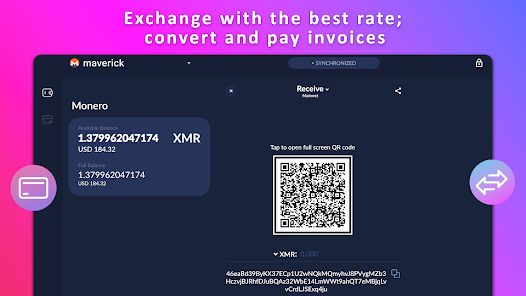
How in-wallet exchange actually works — mechanism, not marketing
At a mechanism level, an on-wallet exchange stitches three moving parts: (1) routing and pricing discovery, (2) the on-chain or cross-chain execution path, and (3) local key control and signing. In the case study wallet, routing uses a system called NEAR Intents: it queries multiple market makers and composes a decentralized route to obtain a competitive rate without sending your private keys to a custodian. Execution may happen by atomically swapping tokens across chains, via intermediary assets, or by using market maker liquidity to deliver the target asset to your receiving address.
Crucially for privacy, signing and key custody remain local: the wallet is open-source and non-custodial, so private keys never leave your device. Hardware wallet integration (Ledger, or an air‑gapped Cupcake device) can further segregate signing from networked software. That local custody is one of the strongest protections against third‑party custody risk, but it does not automatically equal strong network privacy.
Where privacy is gained and where it breaks
There are three distinct loci where privacy can be improved or degraded during an in-wallet swap:
1) Network-level anonymity. A Tor-only mode, I2P proxy support, and the option to use custom nodes substantially reduce IP-level linkage between your device and the market makers. Operating from the US, where ISP subpoenas and monitoring are real possibilities, these modes materially lower the chance that your IP is associated with a swap request. However, Tor and I2P are not magic: misconfigured clients, time-correlated activity, or leaks in ancillary requests (push notifications, OS-level telemetry) can still reveal patterns. The wallet’s zero data collection policy eliminates developer-side telemetry, but you must still mind the OS and other apps on your device.
2) On-chain traceability. For coins like Bitcoin and Litecoin, the wallet includes privacy primitives: PayJoin v2, silent payments, UTXO coin control, transaction batching, and support for Litecoin’s MWEB (MimbleWimble Extension Blocks). MWEB is particularly important: when activated, it provides an optional confidential-transaction layer that obscures amounts and links, reducing the chain-level auditability of LTC swaps. For Monero, privacy is native — subaddresses, background sync, and keeping the private view key on-device preserve Monero’s sender/recipient obfuscation. But mixing privacy-enabled coins with transparent ones during swaps can create linkage unless you carefully separate UTXOs and use privacy-preserving routing.
3) Exchange metadata. Even when keys never leave the device and Tor is used, swap intermediaries and market makers necessarily see counterparties and order parameters. NEAR Intents attempts to decentralize and minimize single points of observation by distributing intents across multiple makers, yet each participating maker will see the slice of the flow they participate in. That fragmentation reduces the risk of a holistic rebuild of your activity, but it does not eliminate the possibility that a determined adversary who controls multiple makers or obtains network logs can correlate events. In short: decentralization raises the bar for correlation but does not make correlation impossible.
Case-specific limits and gotchas you must know
Not every coin migration or workflow is seamless. A concrete limitation: Zcash migration from certain Zashi wallets is incompatible with Cake Wallet seed formats because of change address handling. Users must manually transfer funds into a new Cake ZEC wallet. This is an operational privacy consideration: manual transfers can expose amounts and timing. Plan migrations carefully and, if privacy is primary, consider splitting transfers into smaller, timed batches and routing them through shielded addresses as required.
Another practical limit: enabling device-level biometrics (Face ID, fingerprint) improves usability but has legal trade-offs in the US. Biometric data is securely managed by Secure Enclave or TPM, but law enforcement access patterns to biometrics differ from passcode access. If your threat model involves compelled access, review local laws and consider a numeric PIN vs. biometric unlock for sensitive wallets.
Decision-useful framework: choose features by adversary and task
Here’s a compact heuristic you can use when deciding whether to swap inside the wallet or use an external service:
– If your primary adversary is a curious exchange or a centralized service: prefer non-custodial in-wallet swaps. Keeping keys local and using decentralized routing reduces your exposure to custody risk.
– If your primary adversary is a network observer (ISP, national adversary): use Tor/I2P, custom nodes, and avoid revealing addresses in public channels. Use background sync and subaddresses for Monero to avoid reusing addresses.
– If on-chain forensic linking is the worry: prefer privacy layers (MWEB for LTC, Monero for XMR) and use UTXO coin control and PayJoin for BTC to break simple heuristics that chain analysts use. But remember: combining shielded and transparent assets creates metadata signals at swaps; design swaps to avoid immediate re-use of transparent outputs.
Why multi-platform and hardware support matters in practice
Multi-platform availability (iOS, macOS, Android, Linux, Windows) matters because threats differ by device. Mobile devices are convenient but often run many apps that increase fingerprintability; desktop environments can be more controlled but are less portable. Integrating with hardware wallets like Ledger or an air-gapped Cupcake separates signing from network-facing software, which is a stronger defense against remote compromise. If a swap requires live interaction, use a hardware signer to isolate keys during the transaction.
For users interested in trying or evaluating this workflow, the wallet provides an explicit download channel and multi-store availability. You can find the installer directly at cake wallet download — verify signatures and prefer official stores or the verified APK/F‑Droid release to avoid supply‑chain risks.
Practical takeaways and what to watch next
1. On-wallet swaps reduce custodial risk but shift attention to network and maker-level metadata. Use Tor/I2P and custom nodes to reduce IP exposure, and expect decentralization via NEAR Intents to make correlation harder but not impossible.
2. Use coin-specific privacy tools: MWEB for Litecoin, PayJoin and batching for Bitcoin, and Monero’s subaddresses. Mixing privacy and transparent assets requires deliberate UTXO management to avoid linkage.
3. Treat migrations as operational events with privacy cost (the Zcash/Zashi incompatibility is a concrete example). Test with small amounts and staggered timing.
4. Combine hardware signing with non-custodial on-device custody for the best practical balance of security and privacy.
Watch next: adoption and maker behavior. If market makers centralize or start logging more aggressively, the privacy gains from NEAR Intents will shrink. Conversely, wider adoption of MWEB-like extensions and stronger native privacy tech across chains will materially improve swap privacy over time. Those are conditional futures — watch policy, maker practices, and protocol adoptions.
FAQ
Does swapping inside the wallet guarantee my privacy?
No. In-wallet swaps lower custody risk and can reduce telemetry, but they do not guarantee anonymity. Network-level leaks, market-maker metadata, and on-chain linkages can still reveal associations. Use privacy modes (Tor/I2P), coin-specific privacy features, UTXO control, and hardware signing to reduce exposure. Even then, sophisticated correlation remains possible in some scenarios.
Is Litecoin with MWEB as private as Monero?
Not exactly. MWEB adds a confidential-transaction layer to Litecoin that obscures amounts and improves privacy, but Monero’s protocol is privacy-by-default for amounts, senders, and receivers. MWEB is an optional privacy layer and will depend on whether counterparties and services support or respect MWEB outputs. Both improve privacy, but their threat models and guarantees differ.
Should I use biometrics to unlock my privacy wallet?
Biometrics increase convenience and are protected by hardware enclaves, but in some jurisdictions they carry different legal exposure than a passcode. If your threat model includes compelled access or legal seizure, consider whether a numeric PIN or passphrase better matches your preferences.
What if I need to migrate Zcash from a Zashi wallet?
Because of change-address handling differences, Zashi seed phrases are incompatible. You must manually transfer funds into a newly created ZEC wallet. Plan this transfer carefully and consider splitting amounts and timing to reduce on-chain linkage.
Leave a Reply